
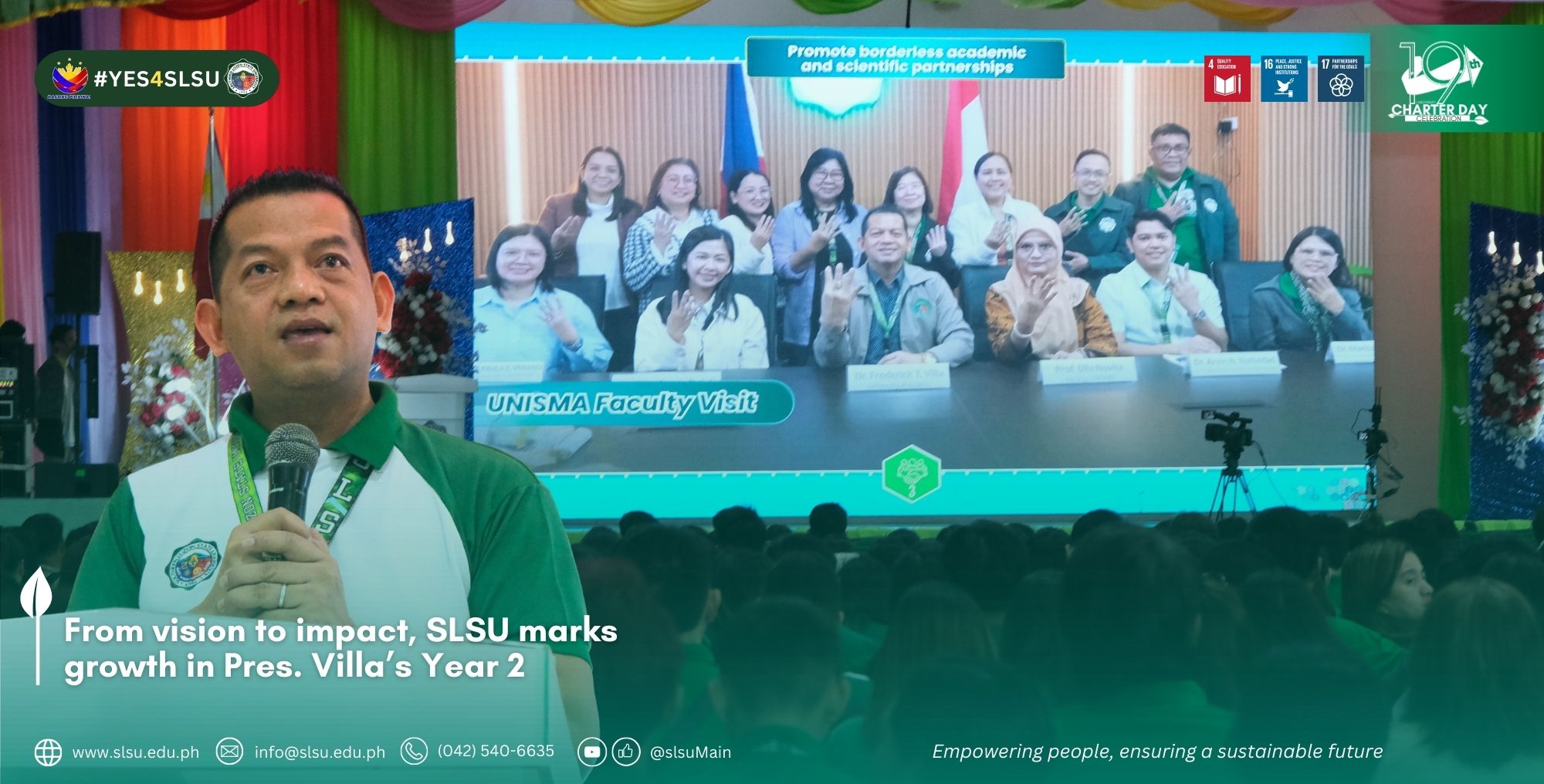
“We will continually turn plans into program; and programs into impact; and impact into lasting change for the communities we serve… Because the mission of a University is not simply to educate minds, but to awaken purpose…” University President Frederick T. Villa, DTech, declared at the opening program of the 19th Charter Day Celebration of Southern Luzon State University.
March is not just the month to celebrate Southern Luzon State University’s Charter Day; it also marks the anniversary of the presidency of Dr. Frederick T. Villa. Since his assumption in March 2024, he set a clear agenda to elevate academic standards, strengthen community engagement, and build SLSU’s R&D capacity.
Using the Y.E.S.S.L.S.U. framework from SLSU’s Strategic Development Plan 2025–2030, Dr. Villa’s administration established new partnerships, opened key R&D facilities, and initiated curricular and program improvements that positioned SLSU for accelerated impact.
In Year Two, Dr. Villa moved from planning to delivery by turning strategic priorities into measurable outcomes. He presented these achievements in an audio‑visual presentation (AVP) titled “Another Year in Review,” enumerating key accomplishments under each strategic goal.
Goal 1: Yield globally competitive values-driven professionals
SLSU is about to launch new programs, reviewed 45% of programs, achieved 100% COPC, and recorded over 50% graduate employability. Accreditation progressed, with Level III re‑accreditation of programs at 45.9% and Level IV at 13.5%. ISO 21001 Educational Organization Management System (EOMS) preparations are ongoing. Licensure results remain strong, with 73.33% of programs above the national average and an 80.14% first‑time takers’ pass rate.
Student achievements across academics, arts, and sports were highlighted. International ties and mobility expanded via Memoranda of Understanding (MoUs) with Kasetsart University, Universiti Malaya, and EduPhil; University Mobility in Asia and the Pacific (UMAP)/Passage to ASEAN (P2A) exploration; the IMPACT internship MoU with Interskills (Japan); Clark industry linkages; and faculty and student exchanges and assessor roles abroad.
Goal 2: Elevate research, innovation, and technology
SLSU mobilized ₱9.9M in external research funding and delivered 38 completed projects, 33 international articles, 56 conference presentations, and 96 citations. Collaboration grew with seven active government partners and sustained ties with Korea National University of Cultural Heritage‑UNESCO and Kasetsart University.
Intellectual Property (IP) activity accelerated: 10 IPOPHL filings, multiple copyrights/trademarks, two patent/utility registrations, 13 assets pending commercialization, technology licensing deals, and Nnovate Food Products recognized as the first spin‑off.
The Board approved S.U.S.T.A.I.N.S. 2030 as the Research, Development, and Extension (RDE) agenda for 2026-2030; proposal review rate reached 51%, and institutional journals Siyasig and Tilamsik processing articles for peer review.
Research capacity rose with 14.09% of plantilla faculty with at least one indexed publication. R&D facilities, such as the Tissue Culture Laboratory, Microbiology Research and Testing Laboratory, and Technology Business Incubator, became fully operational, while the Tropical Wine Lab completed equipment testing and will be inaugurated on March 17.
The Center for Hazard and Environmental Resource Mapping (CHERM) produced 39 specialized maps and delivered geospatial training; the Mt. Banahaw Nature Conservation and Research Center (BaNaCaRe) now anchors Mt. Banahaw stewardship and conservation research.
Goal 3: Strengthen inclusive and community-responsive services
SLSU supported 1,451 scholars in 2025 with tuition, stipends, allowances, boarding, and exam support. A Diversity & Inclusion Strategy Framework was drafted. Three PWD‑friendly upgrades were completed and two core support services for learners with special needs maintained. Outreach included one international diversity engagement and sustained support for four indigenous peoples groups, with campus‑wide gender, cultural, and disability awareness programs.
Through the Technology Business Incubator, two research outputs were registered as IP and are in commercial use; four incubatees are in the commercialization pipeline and MSME partners are engaged. The university secured one formal LGU partnership and produced policy briefs for local adoption. Extension services completed five internal impact assessments, sustained 48 active partnerships, ran 46 programs reaching 3,658 trainees with high satisfaction rating, and recorded 78.3% of plantilla faculty and 50% of students who participated in extension activities over three years.
Goal 4: Sustain a diverse and empowered university system
Campus expansion advanced with house bills filed to convert Catanauan, Gumaca, Lucena, and Tiaong. Satellite land‑use and the Main Campus Science & Technology Annex planning continue. Institutional resilience strengthened with the Public Service Continuity Plan approved and 1,168 responders trained.
ISO certification for satellites remains a priority. Human resources reforms progressed PRIME HRM (Program to Institutionalize Meritocracy and Excellence in Human Resource Management) training delivered; Merit Selection Plans drafted; 55 staff promoted; 15 plantilla items secured for the proposed College of Medicine; 88% of 561 plantilla positions filled as of February 2026.
Under the capacity building and wellbeing, Faculty and Staff Development Plan was drafted; 21 scholars supported with 10 of them graduated; workforce attended 630 trainings; three percent of plantilla faculty hold post‑master’s or post‑doctoral credentials and 61.92% completed local or international training this year. Wellness and disaster risk reduction (DRR) activities were also institutionalized.
SLSU placed 2nd in the Department of Health (DOH) CALABARZON Blood Donation Drive. Leadership and management seminars complemented scholarship and training efforts
Goal 5: Leverage assets for optimized operations
SLSU approved the Information Systems Strategic Plan 2025–2027 and submitted it to MITHI. Core student services were digitized with a Student Portal, Enrollment System, and New Grade Encoding System. An Open Campus Wi‑Fi trial, records digitalization, and workflow automation for finance, HR, and academics laid the groundwork for end‑to‑end modernization.
The 2025 infrastructure portfolio totals ₱96.67M, with ₱10.29M completed such as the CAM auditorium, Business Resource Phase II, and Comfort Room upgrades. Drainage/wastewater works continue and the Polillo academic building is in procurement.
A ₱50M main‑campus electrical upgrade with 500 kVA generator and 100 kW solar for the library are planned. The BOR approved ₱9.9M for four passenger vans.
Six topographic surveys advanced LUDIP consolidation. Asset management and compliance improved with 100% accurate physical inventory, completed disposals, and processed occupancy permits. Budget execution remains strong with General Appropriations Act (GAA) obligations at 88%, with disbursement at 97%; IGI obligations at 59% and disbursements 90%. The Commission on Audit issued an Unqualified Opinion on 2024 statements. Resource Linkages secured one funding partnership, and the Technology Business Incubator advanced 3 commercialization/licensing/spin‑off arrangements.
Goal 6: Steward environmental protection and conservation
SLSU implemented two green infrastructure pilots, completing 100% of planned monitoring activities under the Public Service Continuity Plan. Readiness was tested through six drills and simulations, training 1,168 responders and prioritizing climate disaster risk assessment and adaptation rollouts. Sustainable operations pilots introduced energy and water conservation measures and expanded waste segregation. BaNaCaRe, in partnership with the Mt. Banahaw Forest Conservation and Protection Unit, led community capacity building and ongoing ecological monitoring.
Goal 7: Unite academe, industry, and stakeholders
SLSU modernized alumni engagement with an updated tracking system and sustained partner dialogue through multi‑stakeholder forums. Donations and grants totaling approximately ₱1.7M funded campus needs and scholarships. Notable donations include LICUP Computer Laboratory at Alabat and a ₱1.3M Audio‑Visual Room at Tiaong from Federation Of Filipino Chinese Chambers Of Commerce & Industry, Inc. (FFCCCII).
The university joined the Massive Coconut Planting Project and received a PhilCoA Region IV‑A certificate of appreciation. Strategic agreements advanced scholarship and placement pathways through Giga Ace 6 scholarship, and MOU with UNO Overseas Placement. The preparatory works continued for an Industry Advisory Board, public‑private partnerships (PPPs), and the Coconut Agro‑Techno Industrial Park.
In the coming years, SLSU anticipates growing public‑private partnerships that will strengthen collaborative work. It commits to operationalizing its strategic agenda, scaling proven programs, and deepening partnerships that deliver measurable impact for the communities and stakeholders that SLSU serve.
As a final note, President Villa said, “We do not end this report with finality; we end it with a promise.” He urged the university to scale proven programs, deepen partnerships, and convert in‑progress initiatives into measurable impact. He concluded, “And together, with faith in one another and in the purpose that unites us, we will continue to move forward. We will not take ‘no’ for an answer, because we always say ‘Yes4SLSU’!”
Article: April Arianne A. de Leon
Photo and Layout: Jake Española