
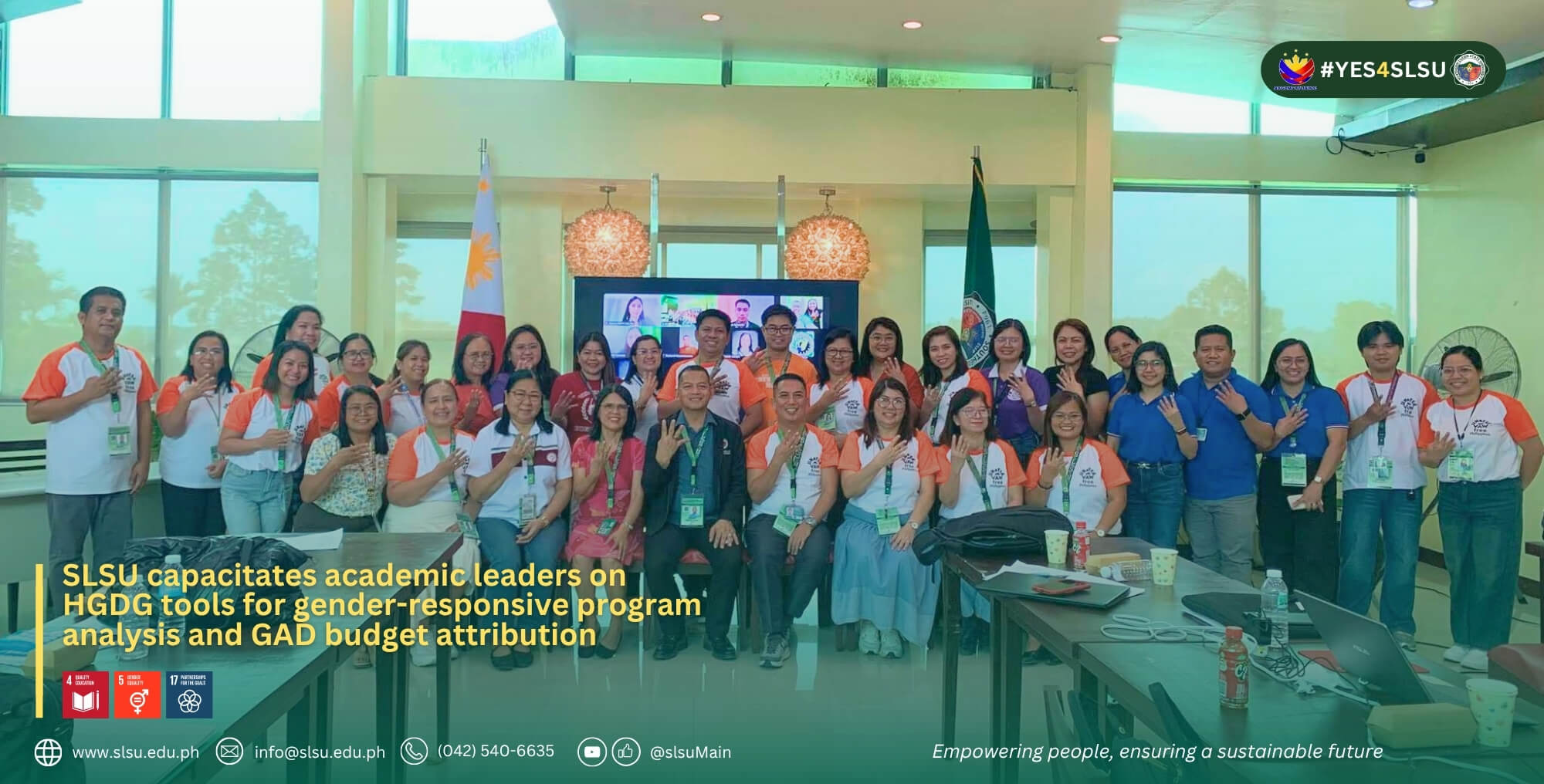
In a significant step towards institutionalizing gender mainstreaming across all academic and administrative functions, the Southern Luzon State University (SLSU) Gender and Development (GAD) Office conducted a two-day capacity building activity on the Harmonized Gender and Development Guidelines (HGDG) for program analysis and GAD budget attribution on July 7-8, at the BRC Hall, with participants joining via video conference from extension and satellite campuses.
The activity was attended by campus directors, deans, program chairs, and other academic leaders, for a total of 109 participants, comprising 61 males (55.96%) and 48 females (44.04%), who underwent intensive training in applying gender perspectives to institutional programs, projects, and activities.
Strengthening institutional capacity for gender mainstreaming
The HGDG, developed by the National Economic and Development Authority (NEDA), the Philippine Commission on Women (PCW), and the ODA-GAD Network, serves as a nationally recognized tool for mainstreaming gender perspectives into development programs and projects. As mandated by Republic Act 9710, or the Magna Carta of Women, government agencies and academic institutions are required to allocate at least 5% of their annual budget to GAD-related activities, a requirement reinforced annually through the General Appropriations Act (GAA).
The training aimed to advance institutional capacity by equipping academic leaders with HGDG tools, ensuring compliance with PCW guidelines on GAD budget attribution, and applying HGDG analysis to all major programs beginning in CY 2026. Beyond compliance, the initiative seeks to promote inclusivity by embedding gender perspectives in academic and administrative initiatives while strengthening accountability in the use of GAD funds through evidence-based program evaluation.
The training aimed to advance institutional capacity by equipping academic leaders with HGDG tools, ensuring compliance with PCW guidelines on GAD budget attribution, and applying HGDG analysis to all major programs beginning in CY 2026. Beyond compliance, the initiative seeks to promote inclusivity by embedding gender perspectives in academic and administrative initiatives while strengthening accountability in the use of GAD funds through evidence-based program evaluation.
Expert lectures and hands-on workshops
Day 1 featured a series of expert lectures delivered by SLSU’s internal resource speakers. Asst. Prof. Jed Frank C. Marqueses opened the session with a comprehensive discussion on gender audit and gender statistics, providing participants with foundational knowledge on assessing gender gaps and measuring gender-responsive outcomes.
Prof. Rene P. Zubieto, Director of the GAD Office, delivered the second lecture on the Introduction to HGDG Tools and Scoring System, walking participants through the standardized checklists used to assess the gender-responsiveness of projects. The HGDG tool yields a maximum score of 20 points for each program or project, with corresponding percentages of the budget that may be attributed to the GAD budget.
The day concluded with an open forum where participants raised clarifications and discussed integration strategies for the topics covered.
Day 2 shifted to a more participatory format. Ms. Rencel E. Mendoza, Admin Officer II of the Budget Office, represented the director of their office, Ms. Maria Cristine D. Absulio, and delivered the session on GAD Budget Attribution and PCW Compliance, clarifying the technical requirements for proper attribution and documentation.
Following the lecture, participants engaged in workshop sessions where they applied HGDG tools to their respective institutional programs through group work. Selected GAD coordinators then shared their experiences, best practices, challenges, and lessons learned in implementing gender mainstreaming initiatives across different campus settings.
The training concluded with the presentation of group outputs, allowing participants to receive feedback and refine their program analyses before applying these tools to their respective units.
Prof. Rene P. Zubieto, Director of the GAD Office, delivered the second lecture on the Introduction to HGDG Tools and Scoring System, walking participants through the standardized checklists used to assess the gender-responsiveness of projects. The HGDG tool yields a maximum score of 20 points for each program or project, with corresponding percentages of the budget that may be attributed to the GAD budget.
The day concluded with an open forum where participants raised clarifications and discussed integration strategies for the topics covered.
Day 2 shifted to a more participatory format. Ms. Rencel E. Mendoza, Admin Officer II of the Budget Office, represented the director of their office, Ms. Maria Cristine D. Absulio, and delivered the session on GAD Budget Attribution and PCW Compliance, clarifying the technical requirements for proper attribution and documentation.
Following the lecture, participants engaged in workshop sessions where they applied HGDG tools to their respective institutional programs through group work. Selected GAD coordinators then shared their experiences, best practices, challenges, and lessons learned in implementing gender mainstreaming initiatives across different campus settings.
The training concluded with the presentation of group outputs, allowing participants to receive feedback and refine their program analyses before applying these tools to their respective units.
A commitment to gender-responsive governance
This initiative aligns with the Philippines’ international commitments under the Convention on the Elimination of All Forms of Discrimination Against Women (CEDAW) and the Beijing Platform for Action, both of which call for the elimination of gender-based discrimination and the institutionalization of gender mainstreaming in governance and development. The Philippine Plan for Gender-Responsive Development (1995-2025) further provides the long-term framework guiding these efforts.
Similar capacity-building initiatives have been implemented across State Universities and Colleges nationwide, as institutions recognize the importance of the HGDG in formulating and implementing gender-responsive programs, projects, and activities. The HGDG training serves as a foundation for institutionalizing gender mainstreaming practices, ensuring that development plans are not only aware of or sensitive to gender issues but also address key, relevant gender-related concerns.
Similar capacity-building initiatives have been implemented across State Universities and Colleges nationwide, as institutions recognize the importance of the HGDG in formulating and implementing gender-responsive programs, projects, and activities. The HGDG training serves as a foundation for institutionalizing gender mainstreaming practices, ensuring that development plans are not only aware of or sensitive to gender issues but also address key, relevant gender-related concerns.
Article: Joyce S. Andrade
Layout: Jefferson L. Abris