
Knowledge is one of the most valuable resources of a university. It is created through research and innovation, enriched by the experiences of its people, and strengthened when it is shared with those who can learn from and use it.
Through the Knowledge Management Office (KMO) of Southern Luzon State University (SLSU), knowledge does not simply remain within the pages of research papers or institutional records; the University continues to build pathways that allow knowledge to be documented, communicated, and brought closer to wider audiences.
At the heart of these efforts are the services of KMO for research publication and knowledge mainstreaming.
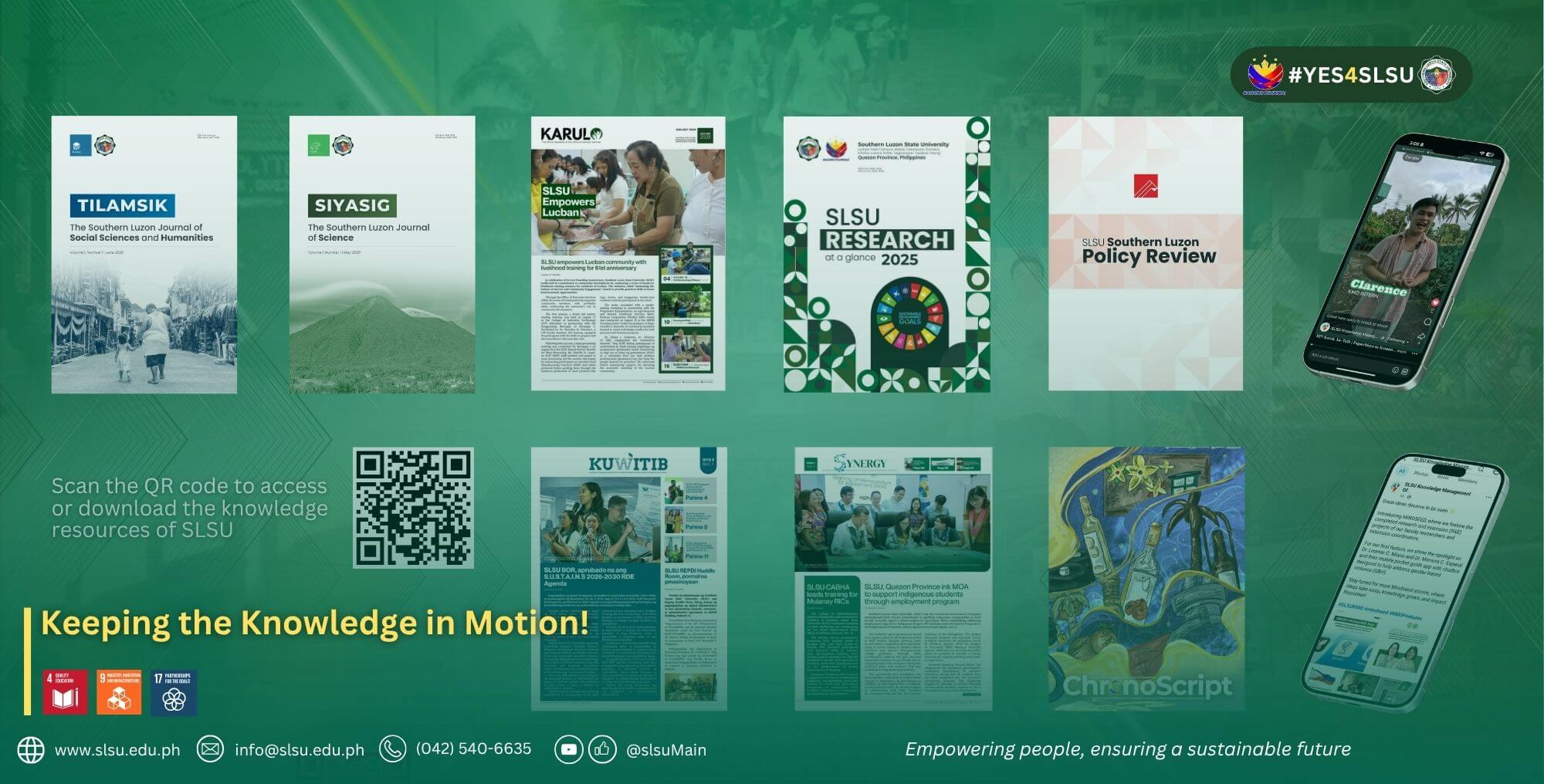
Through its Research Publication Division, the University provides a platform for the formal dissemination of scholarly work through its official research journals. The Division maintains the periodic publication of Siyasig, which focuses on the sciences, and Tilamsik, which features research in the social sciences and humanities. By providing spaces where research can be formally published and accessed, the University contributes to the wider exchange of ideas and advances knowledge within and beyond the institution.
Complementing these efforts is the annual Research at a Glance, which provides a consolidated view of the University’s research accomplishments. Through this publication, the breadth of research and scholarly activities undertaken by the University is made more visible, allowing stakeholders to gain a clearer picture of the knowledge being generated across different disciplines.
While scholarly publications provide a formal avenue for knowledge dissemination, knowledge becomes more impactful when it reaches audiences beyond traditional academic circles; this is where the Knowledge Mainstreaming Division plays a vital role.
Through its various publications, the Division helps communicate research, institutional developments, and experiences in forms that are more accessible to a broader audience. Its quarterly newsletters, including Kuwitib, Synergy, Karulo, and Chronoscript, provide platforms for documenting and sharing stories, updates, and insights from across the University.
These knowledge products contribute to the development of an institutional culture where information and experiences are not only recorded but also shared. In doing so, they help strengthen awareness of the University’s work and connect members of the academic community and its stakeholders to the knowledge being generated within the institution.
Also recognizing the changing ways through which people consume information, the University has explored digital platforms and creative approaches to knowledge dissemination.
Through initiatives such as Katok, Ka-Talk reels, and the MINDSEED feature series, university research and institutional knowledge are presented through engaging and accessible digital content. Beyond lengthy reports and technical publications, research and institutional stories can be translated into short-form videos, visual content, and feature stories that make complex ideas easier to understand and more engaging for wider audiences.
But perhaps one of the most significant pathways for knowledge to create broader impact is through its connection to policy and decision-making.
Through the Southern Luzon Policy Review (SLPR), the University provides a platform for publishing and disseminating policy briefs that translate research-based insights into concise and accessible recommendations. By presenting evidence and possible courses of action in a format that can be readily examined by policymakers and stakeholders, these knowledge products create opportunities for research findings to contribute to discussions and decisions beyond the academe.
At SLSU, knowledge takes many forms and travels through many channels. It can be found in the pages of a research journal, in an annual research compendium, in a newsletter, in a short digital reel, in a feature story, or in a policy brief that are accessible through https://www.slsu.edu.ph/knowledge-management-office/. Each serves a different purpose, but they all contribute to a shared goal: ensuring that the knowledge created within the University does not remain confined to the institution.
Knowledge creates greater value when it reaches people, sparks conversations, informs decisions, and inspires action – and this is how we keep knowledge in motion.
Article and Layout: Maxinne Juacalla